

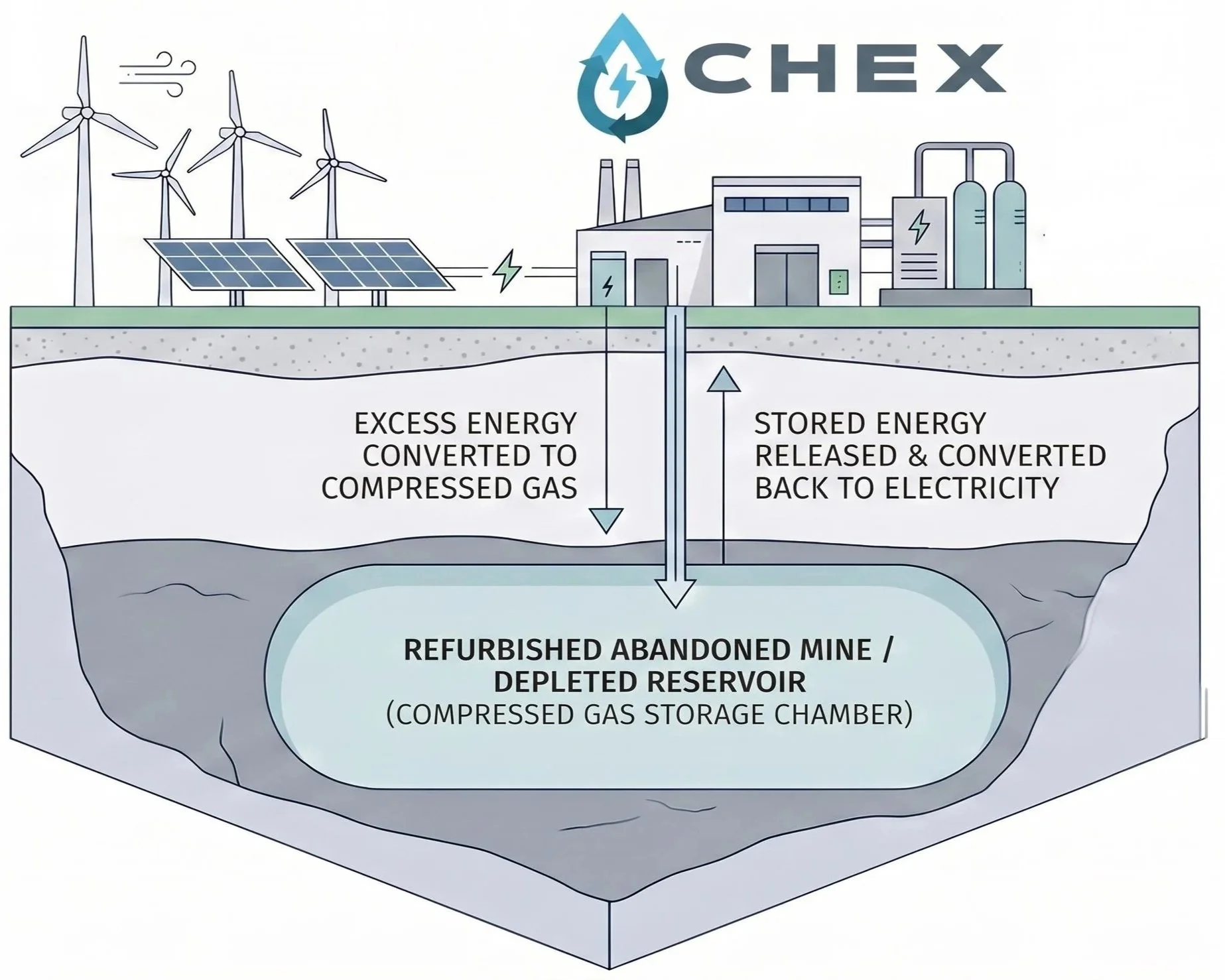
Diagram of Chex’s internal workings
CHEX Energy Storage
CHEX Energy Storage (CHEX) is our award-winning, patented long-duration energy storage technology, designed to efficiently store and recover energy in a sustainable and reliable way.
By combining compressed gas, water, and hydraulic systems, CHEX provides a scalable solution for storing renewable energy and improving energy flexibility. The technology enables the integration of intermittent energy sources, reduces energy curtailment, and supports the development of more resilient and sustainable energy systems.
Unlike conventional battery technologies, CHEX does not require environmentally harmful chemicals to operate. By using abundant and sustainable resources, it offers a long-term solution for large-scale energy storage while creating opportunities to repurpose existing underground infrastructure.
In essence, CHEX functions as a virtual dam, generating electricity through the continuous movement of a fixed volume of water driven by the expansion of compressed gas.
CHEX can be adapted to different applications and storage requirements, making it a versatile technology for the future of clean energy.
Compressed-air Energy Storage Is Now a Reality
As the world transitions towards renewable energy, large-scale and long-duration energy storage is becoming increasingly important. Compressed-air energy storage is one of the technologies being developed to address this challenge, as illustrated by the project featured here.
CHEX takes this concept further by combining compressed gas with highly durable, low-RPM water turbines, which generate electricity as the compressed gas is released. This approach enables CHEX to harness proven technologies while offering a scalable and efficient solution for long-duration energy storage.
Watch the video to see how large-scale compressed-air energy storage is already becoming a reality.
Repurposing Underground Infrastructure
One of CHEX's unique advantages is its ability to utilize existing underground infrastructure, including abandoned mines, depleted oil and gas reservoirs, and inactive wells, as large-scale storage facilities for compressed gas.
By repurposing these existing assets, CHEX significantly increases the scalability of long-duration energy storage while reducing the need for new infrastructure. This approach not only lowers development costs but also gives new economic value to abandoned industrial sites, supporting a more sustainable and circular use of land and resources.
As energy storage demands continue to grow, existing underground infrastructure provides a practical pathway to deploy large-scale storage capacity while minimizing environmental impact.
Applications & Advantages
CHEX Energy Storage provides a sustainable and scalable solution for the challenges of the energy transition. Its long-duration storage capacity allows renewable energy to be stored and delivered when needed, helping to reduce energy curtailment and improve grid flexibility.
10+ hours of storage
>60% electrical conversion efficiency
1–200 MW scalable
300 kg CO₂ avoided per MWh
Built with industry-tested components
With a simple design, electrical conversion efficiency above 60%, and more than 10 hours of energy autonomy, CHEX offers a reliable alternative for large-scale energy storage applications.
The technology can be scaled from 1 MW to 200 MW, making it suitable for different energy requirements, from industrial applications to grid-scale projects. By avoiding the use of chemical storage materials, CHEX generates no chemical waste or direct CO₂ emissions during operation.
For every MWh stored and recovered, the technology can contribute to avoiding approximately 300 kg of CO₂ emissions, supporting a cleaner and more sustainable energy future.
Advantages of Energy Storage for Energy Curtailment Problems